

The Tool Was Never The Point
The Eternal Struggle of the Next Generation of Artists and Craftspeople

There is a sentence that gets said in every workshop, every studio, every conservatory, in every century, by someone who has spent their whole life mastering one way of making things. The sentence is some version of that isn’t real art. It has been said about the pencil, the press, the camera, the phonograph, the synthesizer, the mouse, and now the prompt. The accent changes. The complaint does not.
I want to walk through the history of that sentence, because once you see the pattern, you cannot unsee it. And once you cannot unsee it, you stop being afraid of whatever tool happens to be scaring everyone this week.
The first person to panic was Socrates
Start at the beginning, or close enough. In Plato’s Phaedrus, Socrates tells a little story about the Egyptian god Theuth, who invents writing and proudly presents it to the king as a gift that will make people wiser and improve their memory. The king is not impressed. He warns that writing will do the opposite. People will stop remembering things and start trusting marks on a page instead. They will seem to know a great deal while actually knowing nothing, because the words cannot answer a question or defend themselves.
Sit with that. The most foundational technology of human civilization, the one that lets me reach you across distance and time right now, was greeted by one of history’s great minds as a threat to genuine knowledge. He thought the new tool would hollow us out.
He was not entirely wrong about what we would lose. He was completely wrong about what we would gain.
The scribes saw the press as the enemy
Fast forward to the fifteenth century. The printing press arrives, and the people who feel it most sharply are the monks and scribes who have spent their lives copying books by hand. A German abbot named Johannes Trithemius wrote a whole treatise, In Praise of Scribes, defending the holy labor of hand-copying against the cold mechanical reproduction of print. Copying by hand, he argued, was an act of devotion that printing could never match.
Here is the detail I love. To get his argument out to as many people as possible, Trithemius had it printed. He could not resist the reach of the very machine he was warning against. The tool he distrusted was already more useful to his message than the craft he was defending.
They laughed at the Impressionists
By the 1870s the threat was not even a new machine. It was a new way of seeing. When a group of French painters showed work that looked loose, unfinished, full of visible brushwork and light instead of polished surfaces, the critics tore into them. One reviewer, Louis Leroy, mocked a Monet canvas titled Impression, Sunrise and sneered that the whole lot of them were mere “impressionists,” painters of sketches who could not be bothered to actually finish a painting.
The insult stuck. The painters kept it. Today the word he meant as a slur hangs over a wing of nearly every major museum on earth. The academy that defined “real” painting in 1874 is a footnote. The people they laughed at are the canon.
Painting was supposed to die when the camera arrived
Then came the machine that was truly going to end it all. When photography matured in the mid nineteenth century, painters genuinely believed it was the end of their art. Why would anyone pay for a painted portrait when a camera could capture a face in seconds, perfectly, cheaply? Legend has it the painter Paul Delaroche took one look and declared that from that day on, painting was dead. (Whether he actually said it hardly matters. Plenty of people felt it.)
The poet Charles Baudelaire went further and dismissed photography as a refuge for failed painters, a servant to art at best, never art itself. A machine could not have a soul, so its pictures could not either.
Painting did not die. It did something far more interesting. Freed from the job of literal representation, which the camera now handled better, painters went and invented modern art. No camera, no pressure to abandon realism. No abandoned realism, no Impressionism, no Cubism, no abstraction. The tool everyone thought would kill painting is the reason painting got weird and brave and alive.
Sousa called the phonograph a menace
In 1906 the composer John Philip Sousa published an essay with the wonderful title “The Menace of Mechanical Music.” He was furious about the phonograph. Recorded music, he argued, would destroy the amateur tradition. Why would families gather around a piano and learn to play and sing together when a machine could do it for them? He predicted the decay of musical skill, the withering of the human voice, a nation of passive listeners instead of makers. He called recorded sound “canned music,” and he did not mean it kindly.
Some of what he feared came true. Fewer of us sit around a piano. But he could not have imagined that the same technology would put Robert Johnson, Aretha Franklin, and a thousand voices from a thousand traditions into the ears of a kid in a town that no orchestra would ever visit. The machine he called a menace became the single greatest engine for spreading music in human history.
And on, and on
The pattern just keeps running. Early film was dismissed as a cheap fairground novelty, beneath the dignity of real theater. Jazz was condemned as crude, degenerate, dangerous to public morals. The electric guitar was not a real instrument. The synthesizer was cheating. The drum machine would put drummers out of work and strip music of its human pulse. Sampling was theft, not composition. Photoshop meant photographers were no longer photographers. Digital painting was not painting because your hand never touched a physical surface. Computer animation had no soul next to drawn-by-hand cels.
Every single one of those tools is now simply a tool. We no longer argue about whether a Stratocaster is a real instrument. We argue about whether someone wrote a good song with it.
What the panic always misses
So here we are with artificial intelligence, and the same sentence is being said again, in the same tone, by people who feel the ground moving under a craft they love. I understand the fear better than most. I make things with my hands and with machines, with chisels and code, and I have felt that flicker of wait, does this still count more than once.
But look at what the panic gets wrong every single time.
The complaint is never really about the tool. Socrates was not worried about ink. Trithemius was not worried about movable type. The painters were not worried about lenses and silver salts. The complaint is about the loss of hard-won mastery, the fear that a difficult skill is about to be made easy, and underneath that, a quiet terror about identity. If anyone can do the thing I spent my life learning to do, then who am I.
That is a deeply human fear and it deserves compassion. But it is a fear about the maker, not about the art. And it has been wrong every time, because it confuses the difficulty of a technique with the value of a work. Those were never the same thing.
The thing that actually survives
Walk through any museum, listen to any song that has outlived its century, read any story that still grabs you by the collar, and ask what you are actually responding to.
You are not moved by the chisel marks. You are moved by the Pietà. You do not care that the cave painters at Lascaux used ground ochre and the charred end of a stick. You care that seventeen thousand years ago, in the absolute dark, someone held up a flame and reached out to press a hand against the stone and say I was here, I saw these animals, I was alive. The pigment is gone from memory. The reaching is not.
The tool is the most forgettable part of any work of art. It is the scaffolding. Nobody weeps at the scaffolding.
What survives, across every form and every century, is always the same handful of things. The message. The story. The feeling. The fingerprint of a real human consciousness trying to tell another human consciousness what it is like to be alive. That is the cargo. Everything else, every brush and lens and string and circuit, is just the truck it rode in on.
Which brings me to what I make
I am not writing this from outside the argument. I have spent a good while now building things in a form most people do not yet have a word for, and the missing word is half the point.
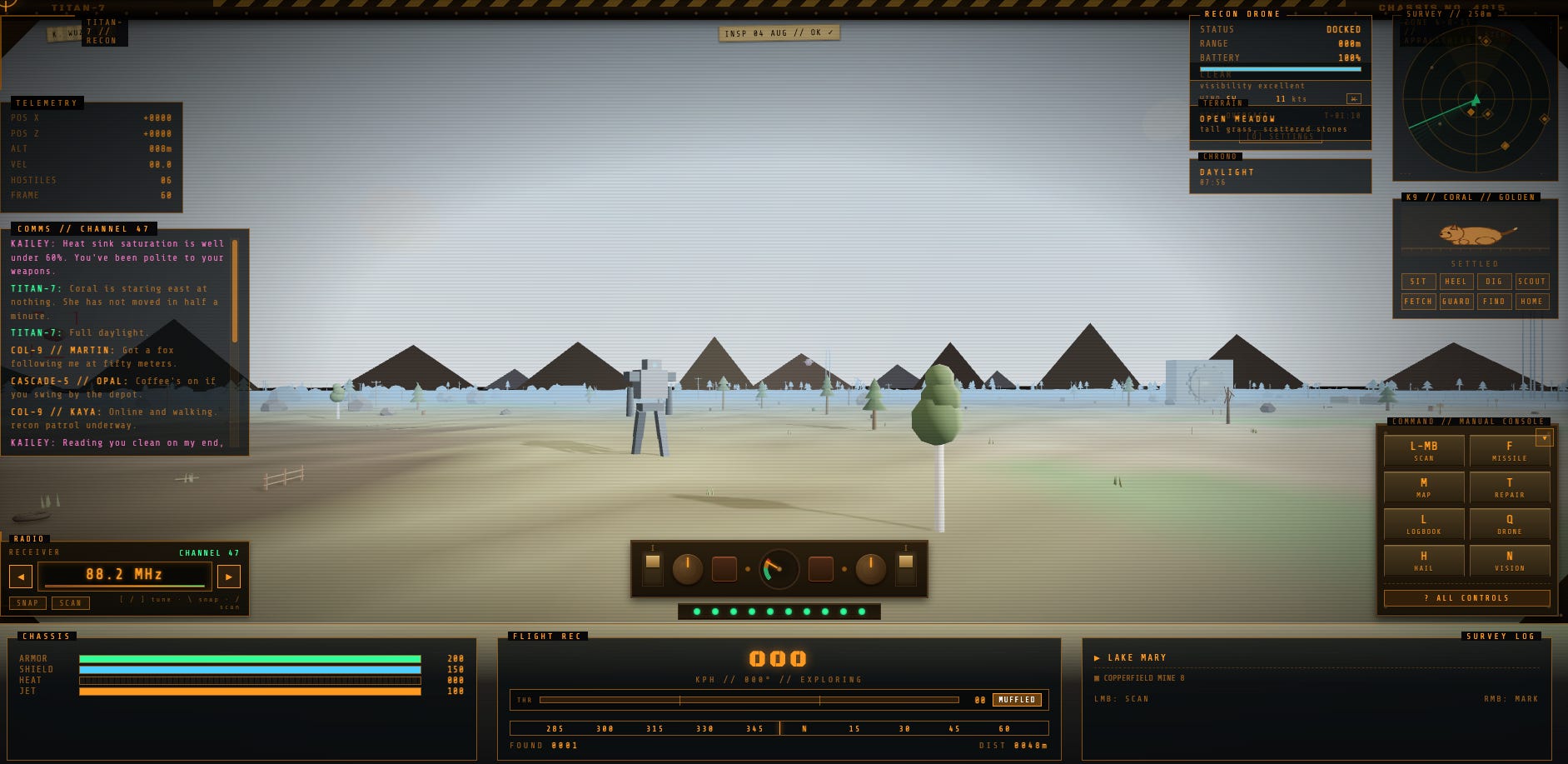
I call them Imagination Engines. Living Paintings. Interactive graphic novels. The Mech Simulator, the Starship ASMR Sim, the Tricorder Sim, Afterware, The Forgotten One, Not Wanted/Not Forgiven. People reach for the closest word they already own and call them games, and they are not games. There is nothing to win and nothing to lose. They reach for simulator, and they are not simulators either. They are not trying to model the real world or test your skill against it. They are doing what a painting does. They are putting you somewhere. The only difference is that in mine you can lean in and turn a dial, and the somewhere leans back.
That is the whole experiment. Atmosphere over challenge. Mood over mastery. The small specific feeling of sitting in a cockpit at three in the morning, alone with the hum and the lights and the slow sweep of a scanner across nothing in particular. A landscape painting with a pulse. A graphic novel you can sit inside of.
If that sounds like a small ambition, look back through the history above. Every new form on that list was dismissed at first for being too easy, too passive, too gimmicky, too unserious, until somebody used it to say something the older forms could not say. I am not claiming I have done that. I am claiming the form can, and that somebody is going to, and the people who do it will not be the ones guarding the old fences. They will be the ones who picked up the new tool and pressed a hand against the new stone.
Where that leaves us
This is the whole reason I keep “ideas over tools” nailed to the wall of how I work. Not because tools do not matter. They matter enormously, and I love them, the more obscure and dangerous the better. But a tool is a means, never the meaning. The soapstone carving, the laser-etched slate, the line of firmware, the chapter of a novel set in these mountains, they are all the same act underneath. A person, reaching out of the dark, trying to say something true.
To make is to be human. That was true with a burnt stick and it is true with a neural network, and the only question worth asking has never changed. Forget whether the tool is real. Ask whether the thing you made with it is honest, whether it carries a message, whether it makes another person feel less alone.
Get that right, and history is on your side. It always has been. The people who master the new tool and pour something true through it are the ones we remember. The people who stood at the door insisting the new thing was not real art are the ones whose names we have to look up.
Pick up the tool. Any tool. Then say something only you could say.