
The Skeptic’s Pivot
Why I Stopped Developing and Started “Vibe Coding”

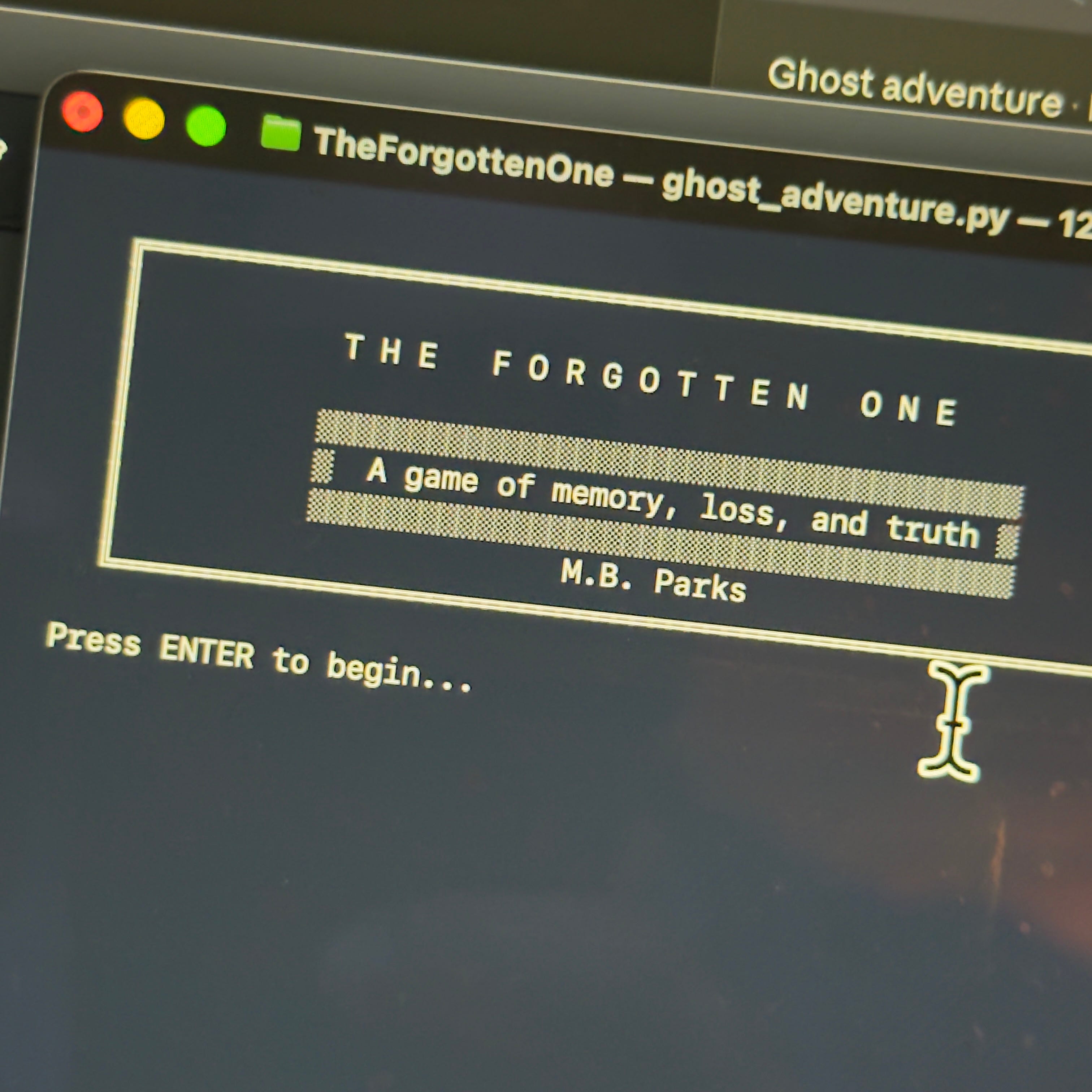
I’ll be the first to admit it: I didn’t want to like this. As a “maker” who values the grit of technical implementation, the idea of “vibe coding”—using high-level AI prompts to manifest a functional game—felt like a betrayal of the craft. I expected the results to be hollow, a low-effort imitation of creativity.
I think I was wrong.
I am of an age where I grew up with text-based adventures. I loved them dearly. For a while now, I have wanted to make my own. I wanted to take my life journey and build something from the good and the bad memory piles (see Doctor Who episode “Vincent and the Doctor”). In building The Forgotten One, I realized that shifting the burden of syntax to an AI didn’t diminish my role; it fundamentally changed it. It moved me from being the software mechanic to being the Digital Craftsman.
The End of the “God View”
The greatest tragedy of solo game development is that you can never truly play your own game. You know where every ghost is hidden because you’re the one who put them there. You’ve read every line of dialogue a thousand times during debugging.
Vibe coding solves the “spoiler” problem. Because I am defining atmospheres rather than exact sequences, I don’t actually know all the details. I know the vibe of the nursery—the faded blue paint, the one-eyed bear—but I don’t know exactly when the music box will trigger its three rising notes.
I’ve authored the “why,” but the machine handles the “how” and the “when.” This means I get to be the First Explorer of my own world. I can sit down, run the code, and actually feel the tension because I’m experiencing the execution for the first time, right alongside any other player.
From Software Dev to Game Author
Traditional development feels like plumbing. You spend 90% of your time ensuring the pipes don’t leak so that the 10% of “story” has a place to go. Vibe coding feels much more like painting.
Software Dev is about the mechanics: “How do I map these coordinates?”
Game Authorship is about the intent: “Why does this room feel heavier than the last?”
When you write a game like a story, the narrative becomes the primary driver of the logic. You are layering textures—the smell of old paper, the pressure in the walls, the warmth of a memory. You aren’t just writing code; you’re conducting a mood.
The Cat is Out of the Bag
Let’s be real: AI is here. The question for us now isn’t whether we should use it, but how we use it to bring out our best versus becoming its slave.
If we use AI to do our thinking, we’ve lost the plot. But if we use it to handle the “drudge work” of logic so we can focus on the soul of the project—the craftsmanship of the experience—we reclaim our creative agency.
I started this project as a skeptic, convinced that “real” games required manual labor at every level. I ended it as a resident of a house I built, yet barely recognize—and for the first time in my life, I’m actually having fun playing a game I made. I might be wrong on all this. But then again, maybe I am just evolving. Just like the journey of life and death.
You can try the game here.