

Giving Rigor to Ethics In Engineering
Ethics Deserves More Than Just A Number Score

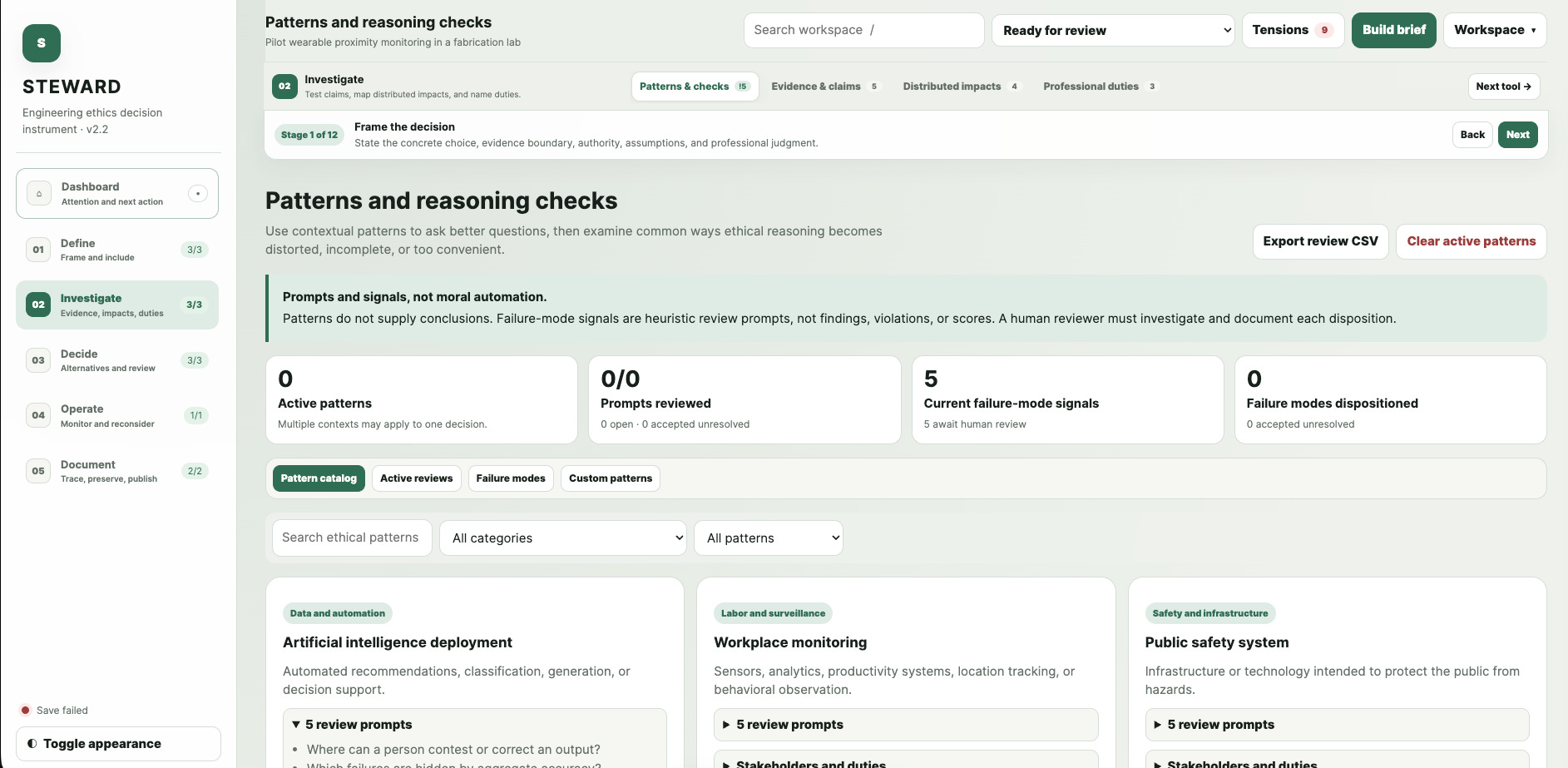
There is a particular kind of software I have come to distrust. You feed it a hard human question, it churns for a moment, and it hands back a number. 82 out of 100. Green. Compliant. Ship it.
The number feels like an answer. It is not. It is a place where the answer used to be, sanded flat so it fits on a dashboard. Everything that made the question hard, who benefits, who pays, which duties collide, where the evidence is thin, who objected and got overruled, all of it gets pressed into a single value that a busy person can approve without reading.
STEWARD is my argument against that. It is an engineering ethics decision instrument, and its whole design starts from one refusal: it will not give you a score.
You can find it at greenshoegarage.com/projects/steward. It is FI-112 in the Field Instruments series. Like everything in that series, it runs entirely in your browser, from a single HTML file, with no account, no server, and nothing uploaded anywhere. More on that in a minute, because the fact that it stays on your machine is not incidental. It is the point.
Why No Number Score
A score is a wonderful thing if your goal is to stop thinking. It compresses. It ranks. It lets a room full of people nod and move on.
But ethics in engineering is not a scalar quantity. When you decide to put a proximity sensor on a worker’s wrist, or defer maintenance on something that will eventually fail, or ship a model that allocates who gets a loan and who does not, you are not producing a value on a line from bad to good. You are distributing things. Safety here, cost there. Privacy taken from the people with the least power to refuse. A benefit that lands on the company and a burden that lands on a maintainer three years from now who was never in the room.
STEWARD holds all of that open instead of collapsing it. It maps stakeholders, benefits, burdens, consent, safety and environmental effects, privacy risk, reversibility, evidence, professional duties, alternatives, safeguards, dissent, monitoring, and the history of the decision itself. Competing obligations stay competing. Weak evidence stays flagged as weak. A minority objection stays visible on the record even after the decision proceeds over it.
Finishing the form does not mean the decision is acceptable. STEWARD is very clear about this. Completeness is not absolution. It hands you a structured, honest picture and then makes you, a human being with a license and a conscience, decide what to do with it.
What it Actually Surfaces
The part I am proudest of is not any single feature. It is the set of things the instrument drags into the light that we are all very good at leaving in the dark.
There is a stakeholder map that plots influence against exposure, and the top left corner has a name: high exposure, low influence. Those are the people who absorb the consequences of your decision and have no practical way to change it. Every ethically ugly engineering decision I have ever seen lives in that corner. STEWARD puts a spotlight on it by default.
There is a failure mode scanner, and it is basically a list of the lies we tell ourselves in review meetings. Legal compliance treated as if it settled the ethics. Schedule pressure dressed up as necessity. Consent theater, where a form got signed but no real choice existed. “No evidence of harm” quietly swapped for “evidence of no harm,” which is a very different and much more comfortable claim. Pilots that become permanent without anyone deciding they should. Burdens described in vague terms while benefits get described in loving specific detail. The scanner does not accuse you of anything. It just asks the uncomfortable question and makes you write down your answer.
And there is a readiness system that, again, refuses to be a score. Instead of a percentage it gives you named states. Not ready. Ready only with exceptions. Approved with conditions. Implemented under monitoring. Reopened. Every state tells you exactly what is blocking it. A blocking professional obligation with no owner. A serious impact with no safeguard. Dissent that was never recorded. You do not get to advance by hitting a threshold. You get to advance by actually resolving the thing, or by explicitly, visibly, deciding to proceed anyway with your name attached.
The Lifecycle Does Not End at Approval
Most ethics processes are a gate you pass through once. STEWARD treats the decision as something that keeps living after you ship it. You frame it, map who is affected, engage them, investigate the evidence, compare real alternatives (including the two we always skip, reduce the scope and do not proceed at all), design safeguards, deliberate, and only then approve.
Then you keep going. You monitor. You log the complaints and the incidents and the unexpected consequences. You watch for scope creep and secondary uses and safeguards quietly weakening. And when reality changes, you can reopen the decision on purpose, with a record of why. The temporary exception that became normal practice does not get to hide. The pilot that became permanent has to answer for it.
You can freeze baselines along the way, compare them, and publish the right version of the record for the right audience, from a full assessment down to a redacted external brief. The lineage stays intact. Someone can come back in two years and see not just what you decided but how, and who dissented, and what you promised to watch.
Why it Lives on Your Machine
Here is the part that makes this a Gears of Resistance post and not a product announcement.
STEWARD runs from a single file, offline, straight off your disk. No account. No server. No telemetry. Nothing uploaded. Your work saves to your own browser’s local storage, and it leaves your machine only when you deliberately export it.
That is a deliberate political choice, not just a technical convenience. The decisions you would use this tool for are exactly the decisions someone might later prefer had no paper trail. The dissent that got overruled. The safeguard that was really just a warning label. The consent that was theater. A tool that phoned all of that home to a vendor’s cloud would be worse than useless. It would be a liability wearing the costume of accountability.
So STEWARD keeps the record where it belongs, with the person who is accountable for it. You own the data. You own the file. If you want to hand it to a regulator or a review board or the public, you do that on purpose, with your own hands. Owning your tools and your data is worth the small friction of managing your own exports. That trade has never been more worth making than it is right now.
What it Will NOT Do for You
I want to be honest about the ceiling, because a tool that overpromised would betray the whole idea.
STEWARD will not produce a score. It will not tell you whether your project is morally acceptable. It will not replace professional judgment, or stakeholder participation, or legal advice, or safety engineering, or environmental review. It cannot prove a safeguard will hold. It cannot turn consultation into consent. It will not let you bury dissent after the fact.
It is an instrument, not an authority. It makes the decision more explicit, more reviewable, more accountable, and easier to reconsider when the ground shifts under it. The judgment stays yours. That is not a limitation I am apologizing for. That is the whole design.
We ask engineers to carry enormous consequences and then hand them tools that help them look away. I wanted to build the opposite. Not something that answers the hard question for you, but something that refuses to let you pretend it was easy.
Go break it. Tell me where it is wrong. It is a field instrument, which means it gets better when people who actually do this work put it under load.
Make. Hack. Learn. Share. Repeat.